HOW AI SEARCH
ENGINES WORK
FROM QUERY EXPANSION TO CITED ANSWERS
What happens behind the scenes of AI-powered search, from the question you ask to the answer you get
When you search on Google, you usually see a list of websites that might have your answer. You pick one, visit the page, and see if it gives you the information you need.
AI search works differently. Instead of just showing a list of websites, systems like ChatGPT Search, Google AI Overviews, Google AI Mode, Perplexity, and Microsoft Copilot can look up information, check several sources, and give you a direct answer.
That answer might include information from different websites. It can compare different claims, bring together separate facts, and give you sources you can check yourself.
But how does an AI search engine choose what to look for? How does it pick which information to use? And why does it cite one website but not another?
To answer that, look at what happens
between your question and the answer on your screen.
Overview
THE FIVE STAGES OF AI SEARCH
Many AI-powered search systems work through five main steps:
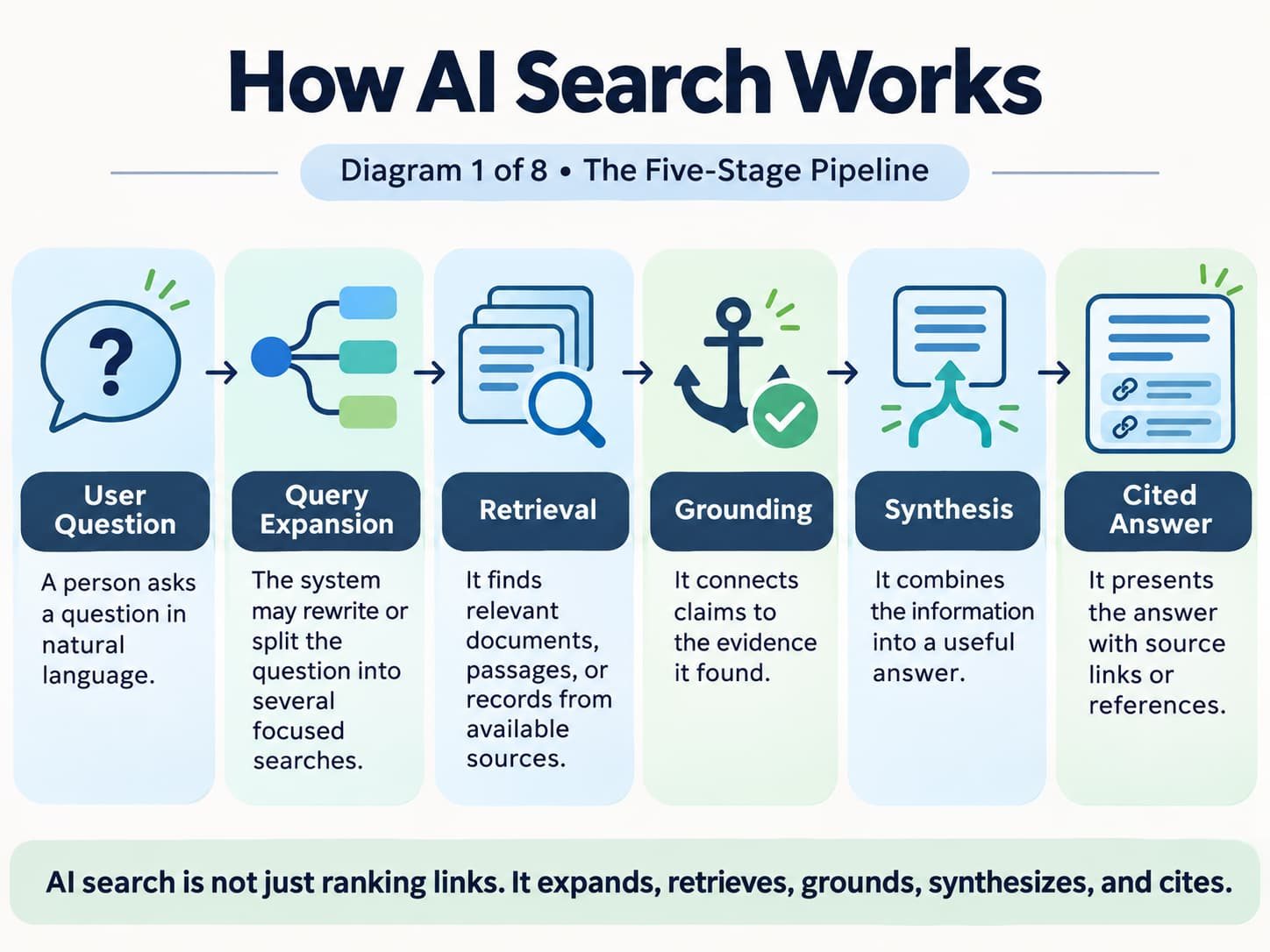
A conceptual model, not a verified internal architecture for every product. Systems may skip, combine, repeat, or reorder stages.
This is a general model, not a strict technical rule. Some systems combine steps, run extra searches while writing an answer, or use different methods depending on the question.
A simple question might not need much outside searching. A complex research question could lead to several rounds of searching, checking, and writing.
The key difference: AI search does more than find websites. It also tries to understand what's on those sites and decides what information should go into the final answer.
Foundation
FIRST, UNDERSTAND RETRIEVAL-AUGMENTED GENERATION
A lot of modern AI search is based on something called retrieval-augmented generation, or RAG.
A large language model (LLM) learns patterns and information during its training. But that training doesn't give it a constantly updated or perfectly accurate database of everything going on in the world.
Retrieval-augmented generation helps with this problem by letting the model access outside information when it needs to answer a question.
For example, a model might know general facts about customer relationship management (CRM) software from its training. But if someone asks about current prices, integrations, or new features, the system can look up more recent information and use it while constructing its answer.
This setup was described in the 2020 research paper Retrieval-Augmented Generation for Knowledge-Intensive NLP Tasks.
RAG is a helpful way to understand AI search, though not every AI search tool uses the exact setup from that paper.
The five stages below show what happens when a system gets a question, looks for outside information, and builds an answer with sources.
01 · Query Expansion
QUERY EXPANSION: ONE QUESTION CAN BECOME SEVERAL SEARCHES
A regular search usually starts with the words you type into a search box. AI search can begin by asking a different question:
WHAT INFORMATION WOULD I NEED
TO ANSWER THIS CORRECTLY?
That distinction matters because people often ask complicated questions that contain several smaller questions. Consider this example: "What's the best CRM for a five-person personal injury law firm in Texas that needs automated client intake and integrates with Clio?"
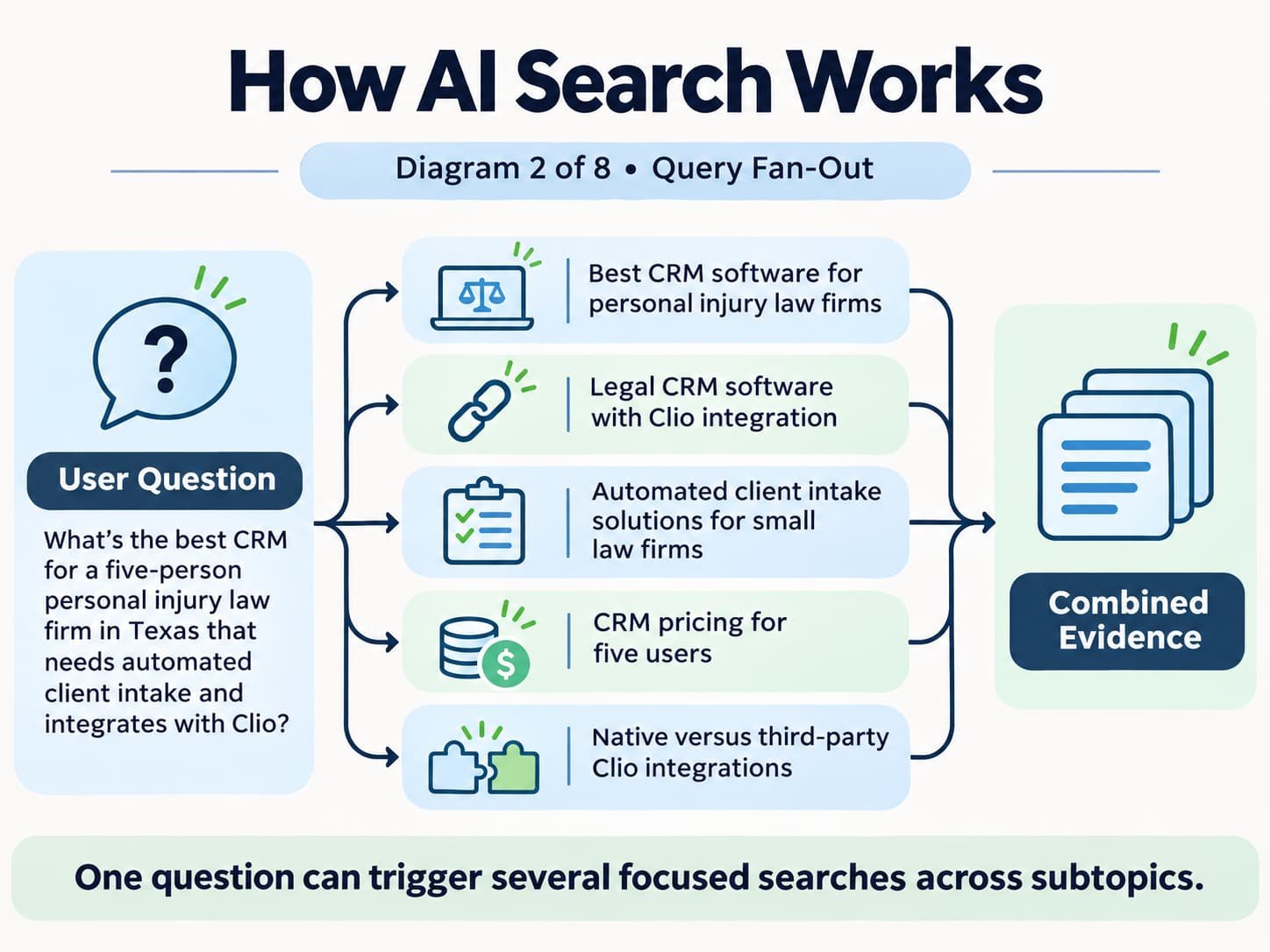
Illustrative example searches, not captured queries from any specific platform.
To answer that question, you need more than websites containing the words "best legal CRM." A helpful answer needs details about law firm software, practice management integrations, automated intake, pricing, and whether the product fits a small firm.
Making extra searches like this is called query expansion.
Why AI search engines expand queries
Query expansion helps solve three main problems.
First, people don't always know the right terms to use. Someone searching for "software that automatically follows up with new legal clients" may be describing lead intake automation, a CRM workflow, or a legal practice management integration. A search system can cover more ground by looking for technical terms the person didn't use.
Second, complex questions often have several requirements. A product might have excellent intake features but no suitable integration. Another might integrate perfectly but cost more than the firm can justify. By breaking these requirements apart, the system can look for evidence on each one.
Third, helpful information is rarely all in one place. A vendor's website may document product capabilities. Its pricing page may list costs. An integration partner may provide compatibility information. Query expansion lets the system investigate each part of the question rather than relying on one broad search.
Query fan-out
Google calls this approach query fan-out. According to Google Search Central's documentation, both AI Overviews and AI Mode may use it, issuing multiple related searches across subtopics and data sources to develop a response.
Instead of making you run several searches, the system can look into related questions and put together what it finds.
This matters for search optimization. A person might ask one question, but the system may retrieve content based on several related questions that were never typed into the search box.
Query rewriting
Query rewriting is a related method in which the system reformulates a question to make answers easier to find. OpenAI publicly documents this behavior for ChatGPT Search.
OpenAI's ChatGPT Search documentation says it typically rewrites a question into one or more targeted queries for its search providers. After reviewing the first results, ChatGPT may send additional, more specific queries.
So the original question and the searches actually sent to an information provider might not be the same.
More advanced expansion techniques
Researchers have developed several approaches for improving how language models retrieve information.
- Query decomposition divides a complicated problem into smaller research questions.
- Multi-query generation creates different versions of a question to improve the chances of finding useful information.
- Step-back prompting has a model look for broader principles before answering a specific question. Research from Google DeepMind showed that this kind of abstraction can help with some reasoning tasks. See Take a Step Back: Evoking Reasoning via Abstraction in Large Language Models.
- Hypothetical Document Embeddings (HyDE) take another approach. Instead of searching directly from the question, the system generates a hypothetical answer-like document and converts it into a mathematical representation used to retrieve real documents.
The hypothetical document may contain incorrect details. Its purpose is to help locate relevant information, not to serve as evidence. HyDE was introduced in Precise Zero-Shot Dense Retrieval without Relevance Labels.
These methods are described in research, but that doesn't mean every commercial AI search engine uses them.
When query expansion goes wrong
More searches do not automatically produce better answers.
A rewritten query can drop an important detail. For example, a search about Texas personal injury practices might turn into a general search about law firm software.
A broad search might find more documents, but fewer of them may be relevant. That reflects a classic information retrieval trade-off:
- Recall
- How much of the relevant information a system finds.
- Precision
- How much of the information found is actually relevant.
Improving one doesn't always improve the other.
What query expansion means for website content
If a question can be broken into several subtopics, content that covers those subtopics may have a better chance of being retrieved.
For a page about legal CRM software, that means clearly explaining pricing, integrations, intake workflows, firm size, and any limitations.
It doesn't mean publishing lots of nearly identical keyword pages. A better approach is to publish useful information that answers the main question and the related questions around it.
The main point: A website should do more than target keywords. It should give people the specific information they need to make a good decision.
02 · Retrieval
RETRIEVAL: HOW AI SEARCH FINDS RELEVANT INFORMATION
Once a search system knows what it needs to look into, it has to find information that could answer the question. This is the retrieval stage.
Retrieval is the process of locating potentially useful documents, passages, database records, or other information from an available collection. That collection might include a public search index, a proprietary database, a third-party search provider, or a private knowledge base.
For our law firm CRM example, the system might retrieve product pages, integration documentation, pricing tables, reviews, and support articles. Finding those sources takes more than looking for matching words.
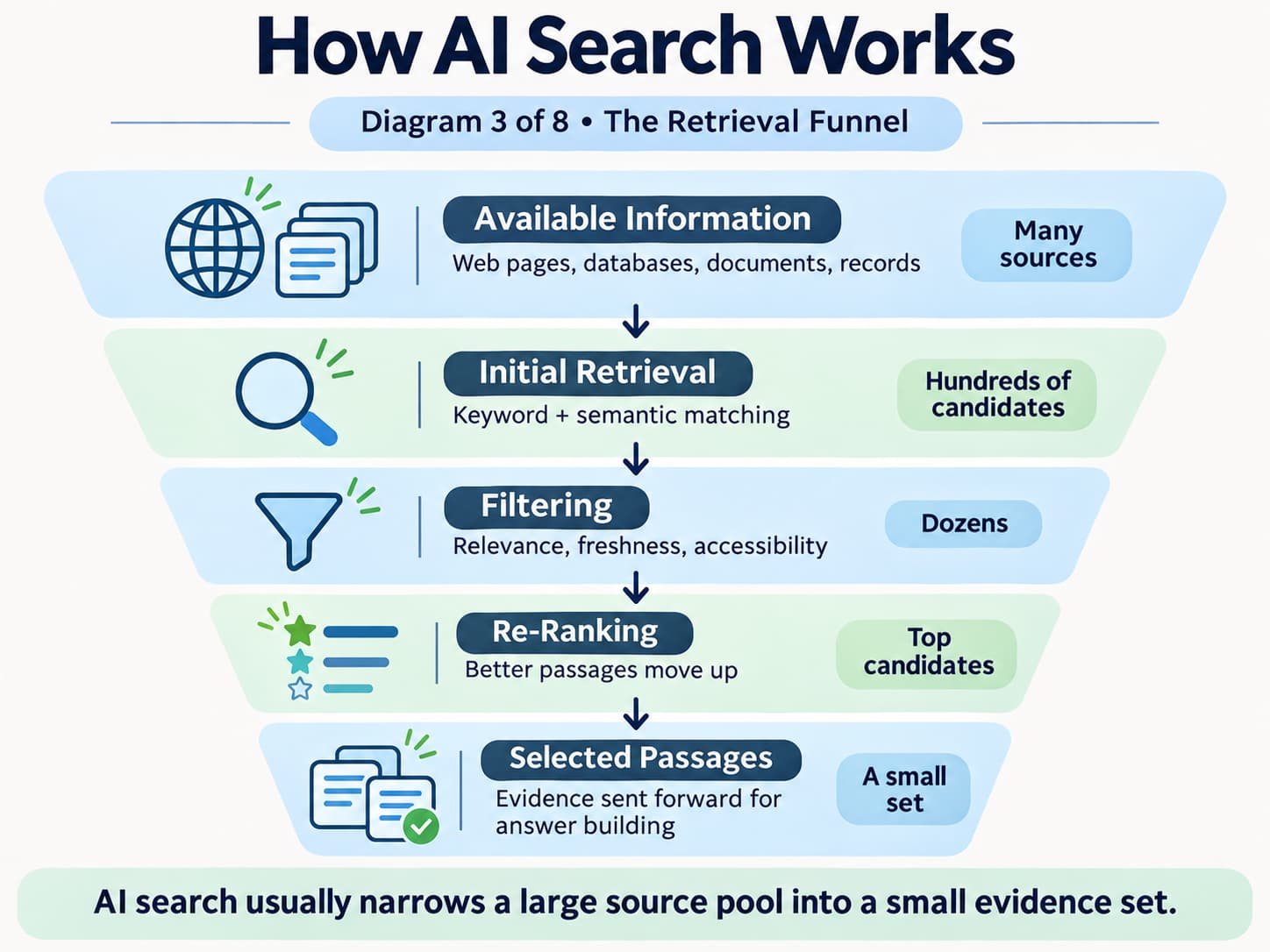
Stage sizes are illustrative, not real platform thresholds.
Keyword retrieval
Traditional information retrieval frequently uses keyword-based methods. A common algorithm called BM25 weighs how often a term appears in a document, how common that term is across all documents, and the length of the document.
Keyword retrieval is especially useful when exact terminology matters. Someone searching for a specific software product, integration name, or model number benefits from precise matching.
But keyword retrieval has limits. A page about "automated prospect follow-up" might be relevant to someone searching for "lead nurturing software," even if it never uses that exact phrase. That's where semantic retrieval helps.
Vector retrieval and embeddings
Modern retrieval systems can represent text using embeddings. An embedding is a set of numbers created by a machine learning model that captures patterns of meaning and relationships in the text.
Documents and search queries can both be converted into embeddings and compared mathematically. This lets a system find similar information even when the exact words differ. For example:
"Software that reminds staff to contact new clients"
"Automated lead follow-up workflows for legal intake"
The words are different, but the main ideas are similar.
Embeddings are stored in systems designed to search vectors efficiently, commonly called vector databases or vector indexes.
Vector search is powerful, but semantic similarity is not the same as factual relevance. A passage can discuss a closely related subject and still fail to answer the specific question.
Hybrid retrieval
Many retrieval systems combine keyword and vector search. This approach is called hybrid retrieval.
Keyword matching preserves precision for exact names, numbers, and terminology. Vector matching helps identify related concepts and paraphrases.
Microsoft's Azure AI Search documentation provides a concrete example. Its hybrid search runs full-text and vector searches in parallel, then merges the ranked results using Reciprocal Rank Fusion (RRF).
RRF combines multiple ranked lists by considering where documents appear in each list. A document that shows up near the top of several result lists may get a higher overall ranking.
Azure AI Search documents this implementation. It should not be read as proof that every consumer AI search engine uses the same algorithm.
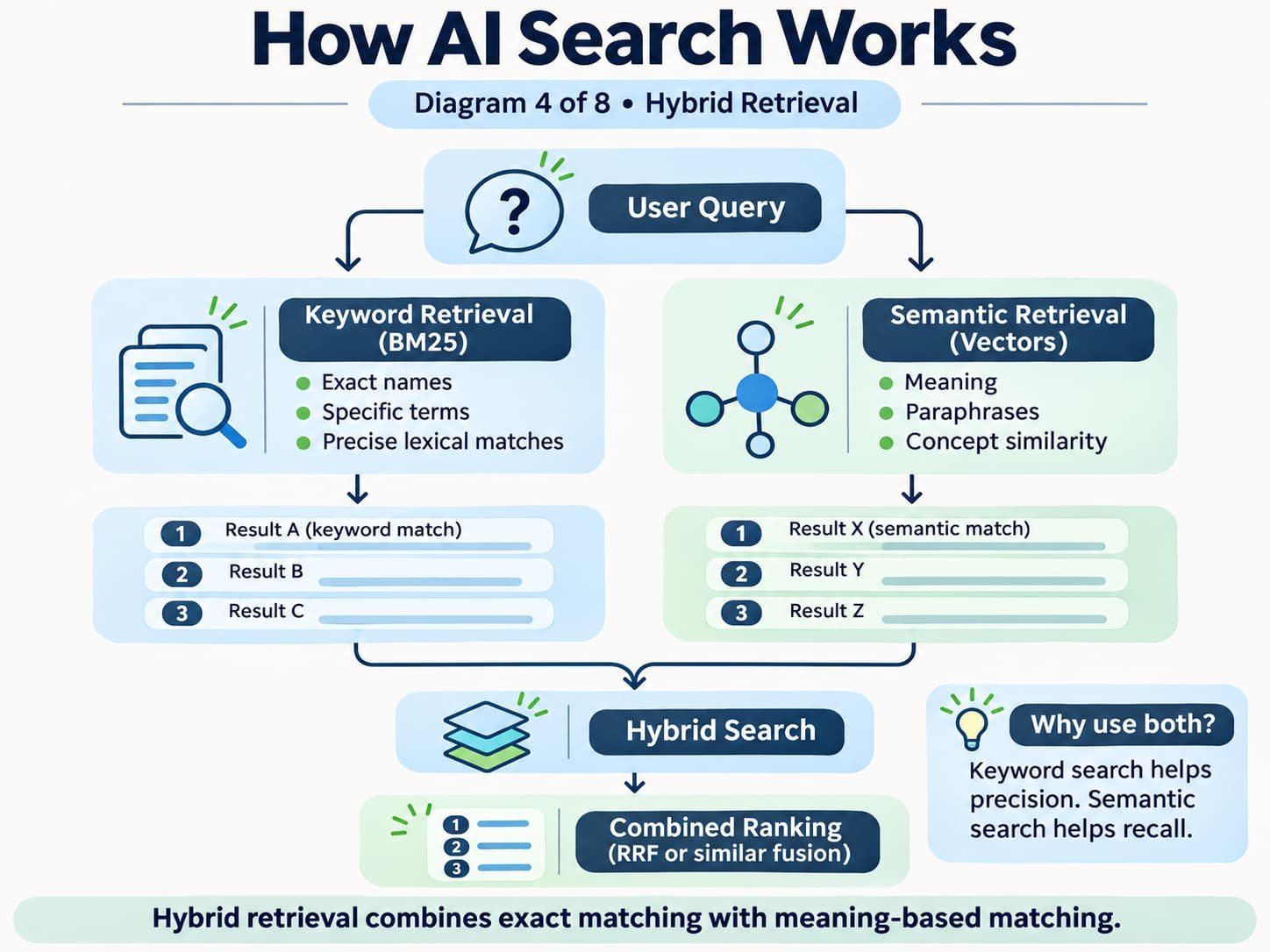
Keyword search helps precision; semantic search helps recall. Fusion merges the ranked lists.
| Method | Strength | Weakness |
|---|---|---|
| Keyword / BM25 | Exact names, product numbers, terminology | Can miss paraphrases |
| Dense / vector | Semantic similarity and related concepts | Can retrieve plausible but imprecise matches |
| Hybrid | Combines lexical and semantic evidence | Requires ranking and fusion decisions |
| Re-ranking | Improves the order of retrieved candidates | Cannot recover documents that were never retrieved |
Document chunking
Retrieval systems also have to decide how much information to take from each document.
Imagine a 5,000-word software comparison page with an introduction, feature descriptions, pricing tables, integration details, and a conclusion. If the question concerns a particular integration, the system may benefit from retrieving that section rather than processing the entire document.
In many RAG systems, documents are divided into smaller pieces called chunks. A chunk might be a paragraph, several paragraphs, or another unit determined by the system's processing strategy.
Chunking helps a system get specific information without handing the whole document to the language model. But it comes with a risk. Suppose one chunk says "The platform supports Clio integration," while the next explains that the integration requires a third-party automation service and does not provide native two-way synchronization.
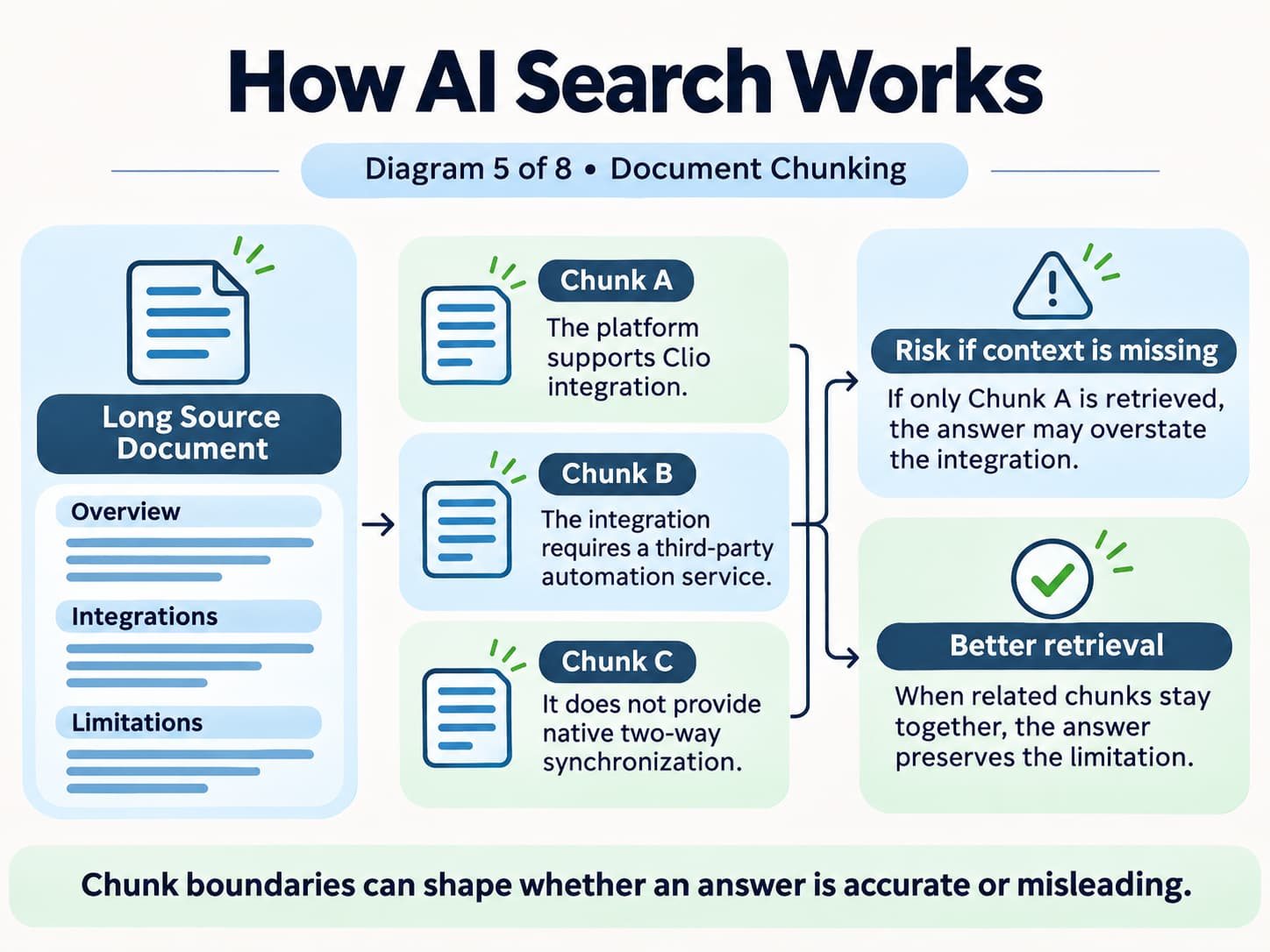
Chunk boundaries can decide whether an answer is accurate or misleading.
If retrieval gets the first statement and misses the qualification, the answer could be misleading.
The size of each chunk, where it starts and ends, and the surrounding context can all affect how well retrieval works. Proprietary consumer search products generally do not disclose their exact chunking strategies.
Re-ranking the results
Initial retrieval may identify dozens or hundreds of candidate passages, and not all of them are equally useful.
A secondary process called re-ranking can evaluate candidates more carefully and reorder them. A re-ranker may examine how well a passage addresses the full question rather than relying only on a keyword or vector similarity score. Microsoft documents semantic ranking as an optional stage in Azure AI Search.
Re-ranking helps put the best candidates first, but it cannot guarantee that the right source was found to begin with.
Where does the information come from?
AI search systems may use different information sources depending on their tools and integrations. Common possibilities include public web pages, search engine indexes, news sources, product databases, structured business information, and private organizational documents.
Google's generative search features rely on Google's Search infrastructure. ChatGPT Search can use third-party search providers to retrieve current information. Enterprise systems may also use permission-controlled internal files.
A system does not necessarily search the entire internet each time someone asks a question. It searches the information available to its particular retrieval tools, indexes, and permissions.
That points to an important limitation: if a document isn't available to the retrieval system, the language model cannot reliably ground an answer in it.
When retrieval goes wrong
Retrieval can fail for several reasons:
- A website blocks crawling, or a page isn't indexed.
- Important information is hidden behind a login or in a format the retrieval system can't process effectively.
- An index contains an outdated version of a page.
- A semantic search retrieves a similar but incorrect product.
- A re-ranker prioritizes a polished comparison article over the original technical documentation.
Each retrieval decision affects what the language model can use afterward.
What retrieval means for website content
For website owners, the priority is making accurate information accessible.
Important content should appear in readable text, use descriptive headings, and be organized so the relationships between subjects are clear.
Technical details should be explicit. Product specifications, integration requirements, pricing conditions, and service limitations should not depend entirely on images or promotional language.
Internal links can also establish relationships between related pages and make important information easier to discover.
The main point: You can't control every retrieval algorithm, but you can make your information easy to find, clear, and specific.
03 · Grounding
GROUNDING: HOW AI SEARCH CONNECTS ITS ANSWER TO EVIDENCE
Finding the right information is only part of the challenge. The next step is making sure the system uses that information correctly. This is where grounding comes in.
Grounding means connecting a generated response to available evidence, such as retrieved documents, verified records, or other supplied information. The goal is to reduce unsupported claims and make answers more reliable.
Grounding matters because language models generate text based on patterns they have learned. Without the right evidence or limits, they can make statements that sound right but are wrong. These mistakes are often called hallucinations.
Retrieval can lower this risk, but giving a model access to documents does not mean it will always interpret them correctly.
An example of grounding
Return to the CRM question. Suppose a vendor's official documentation says, "Our software supports data transfers to Clio using a third-party automation service." An AI search system might answer, "The CRM provides a native two-way Clio integration."
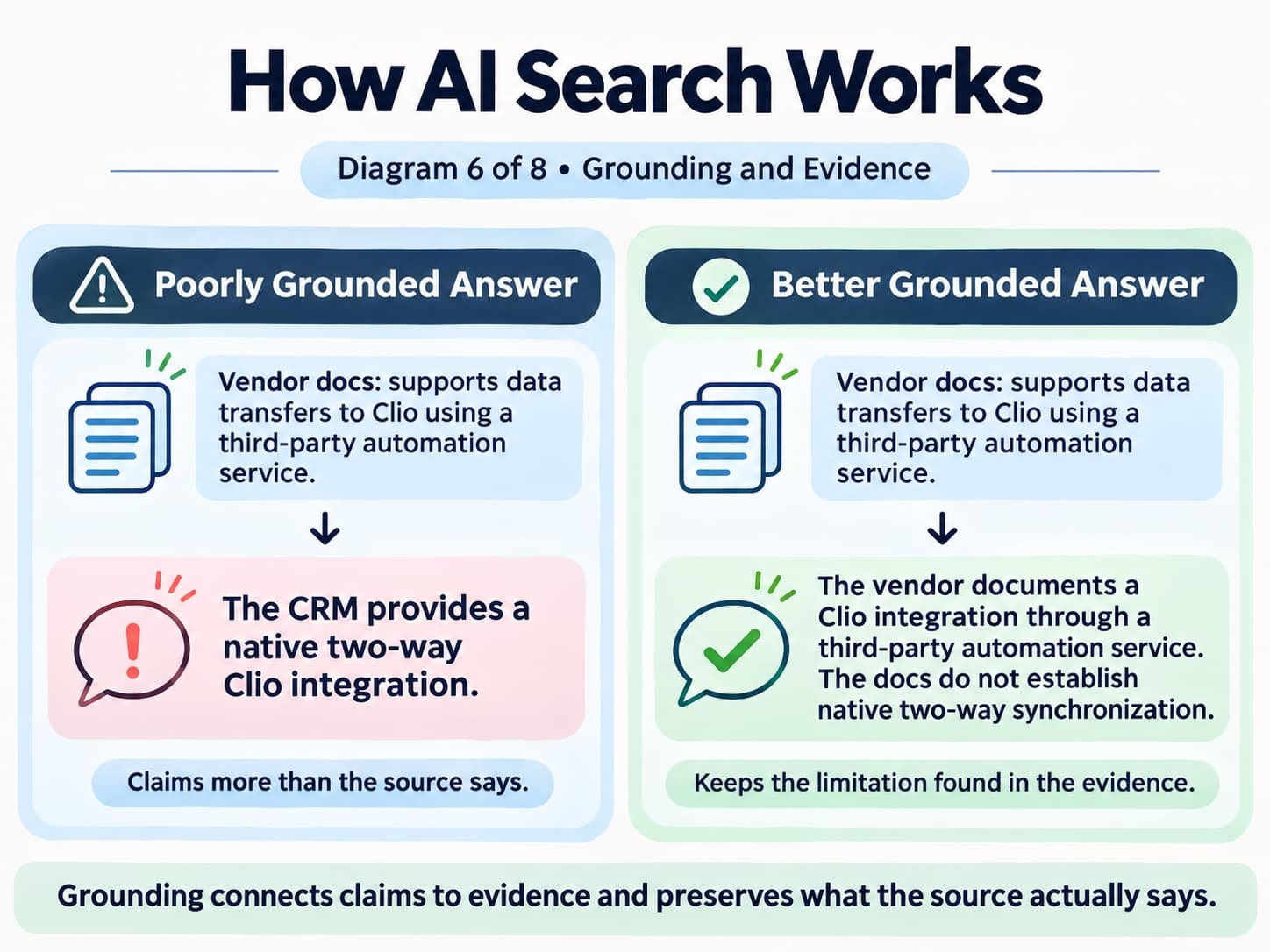
Grounding connects claims to evidence and preserves what the source actually says.
The first answer claims more than the source says. The documentation confirms an integration method, but it does not establish that the connection is native or two-way.
Both answers concern the same product and feature. Only the second keeps the limitation found in the evidence.
How grounding works in practice
RAG-based systems can supply retrieved passages to a language model as part of the context used to generate an answer. The model may be instructed to rely on those passages, avoid unsupported claims, or acknowledge when the available information is insufficient.
Other designs may attach source identifiers to evidence, check claims against retrieved text, or perform additional verification.
Grounding is not always a separate model or a clearly isolated step. Some systems build it directly into answer generation; others add components for verification. Methods vary, and commercial platforms generally do not disclose every internal verification process.
What happens when sources disagree?
Imagine the CRM vendor's pricing page lists one monthly price, while a third-party review lists another. Which should the AI search system use?
A responsible answer investigates the discrepancy. The sources may describe different subscription plans, billing periods, markets, or product versions. The third-party article may be outdated.
The vendor's current pricing page is usually the best source for current advertised prices, but even official documentation can be incomplete or carry special conditions.
A good answer keeps those differences clear rather than collapsing conflicting information into a single, overly confident statement. If the evidence doesn't fully answer a question, it's better to admit uncertainty than to pretend to be sure.
GROUNDED DOES NOT MEAN TRUE.
A RESPONSE CAN FAITHFULLY SUMMARIZE AN INCORRECT SOURCE.
Grounding is not the same as truth
A response might summarize a source correctly and still be factually wrong if the original document contains a mistake.
For example, an outdated article may claim a software integration is available after it has been discontinued. If a model repeats that claim, the answer is grounded in its source but no longer accurate.
Grounding describes how an answer relates to its supporting evidence. Whether an answer is true depends on how good, relevant, current, and well-interpreted that evidence is.
The risk of manipulated sources
Not every retrieved source can be trusted. Some pages contain false information, fabricated claims, or even instructions meant to manipulate AI systems.
One major risk is prompt injection: untrusted content, like a web page or document, includes instructions meant to change how the assistant behaves. A malicious page might try to make a model ignore its task or promote a certain product.
Retrieval systems should treat outside information as evidence to evaluate, not as commands that override their actual job.
What grounding means for website content
Grounding is a real reason to publish evidence that backs up specific claims.
If a business says it has finished 500 projects, documentation for that number is more useful than repeating the claim. If a product offers an integration, describe how it works, what it includes, and where its limits are. If a company shares research, include the method, the date, and the underlying data when possible.
Good source material helps an AI system build more accurate answers.
The main point: Being easy to find matters, but so does having evidence that supports the claims an AI system might repeat.
04 · Synthesis
SYNTHESIS: HOW AI SEARCH TURNS INFORMATION INTO AN ANSWER
Once it has the right information, an AI search system needs to turn it into something helpful. This is synthesis: selecting information, comparing findings, resolving differences, and putting it all together into a clear answer.
In traditional search, users often assemble their own conclusions from several websites. AI search may do much of that work inside the answer itself.
From multiple sources to one recommendation
Think about what our CRM search could find: a vendor pricing page with subscription costs, integration documentation describing the Clio connection, a help article on automated intake, and an independent review covering usability and limitations.
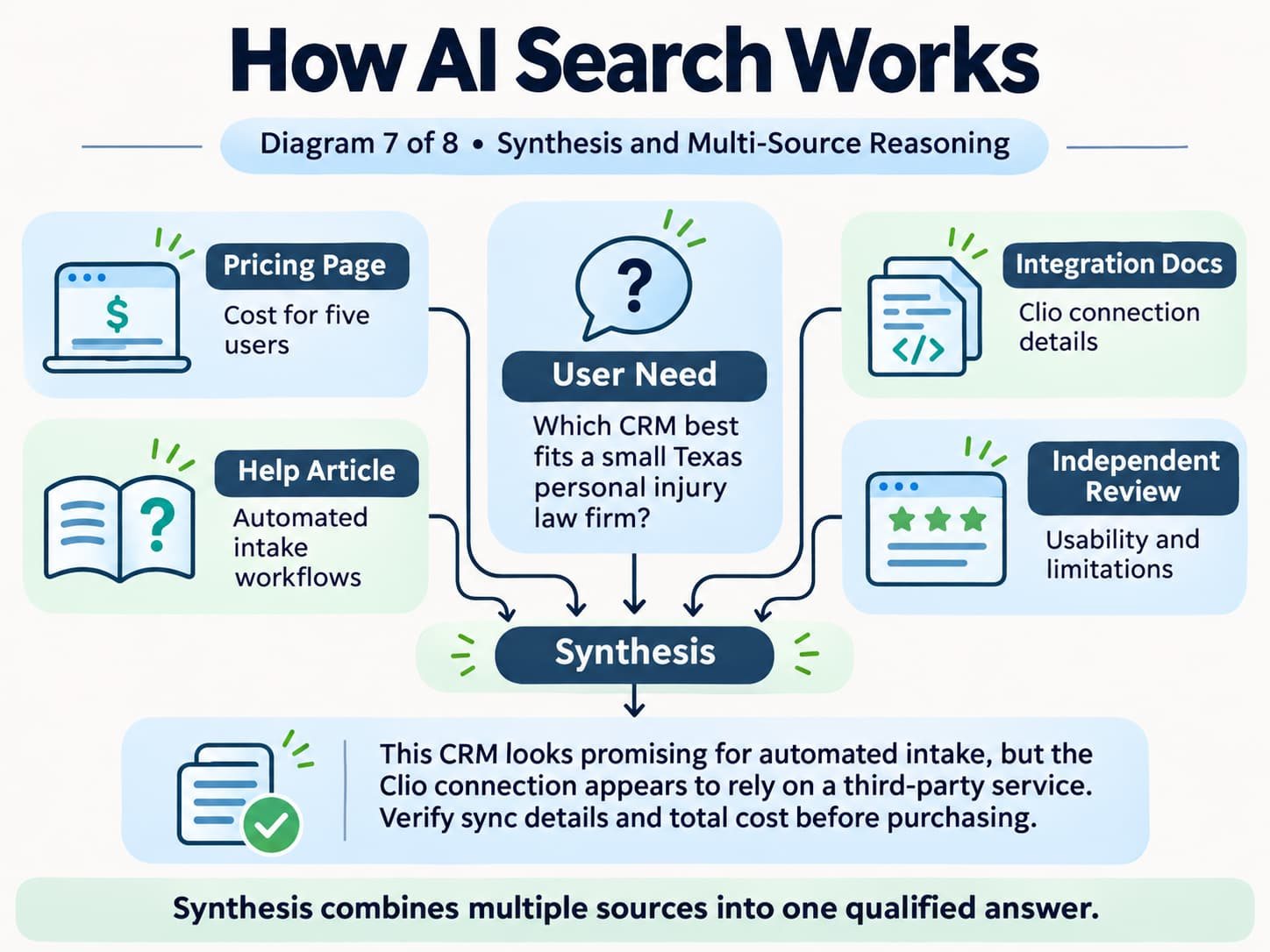
Synthesis combines multiple sources into one qualified answer.
The language model needs to connect these findings back to what the user originally asked. A weak answer just summarizes each website on its own and never reaches a useful conclusion. A stronger response might say:
"This CRM appears suitable for a five-person firm that prioritizes automated intake. However, its documented Clio connection uses a third-party service, so the firm should verify synchronization capabilities and total integration costs before purchasing."
That answer goes beyond repeating facts from sources. It organizes the evidence to support a business decision.
Multi-hop reasoning
Some questions need information from several sources before an answer is possible. This is called multi-hop reasoning.
Answering whether a particular CRM fits a firm's budget might require looking up the subscription price, determining the number of licenses, identifying integration fees, and comparing the total against the firm's stated budget. No single source has the complete answer, so the system has to link separate pieces of evidence.
Multi-hop reasoning is helpful, but each connection adds a chance for error. If the price is old or the integration fee is misunderstood, the final answer can be wrong even when every source looks relevant.
How AI search prioritizes information
When synthesizing, a system may emphasize some information over other details. Relevance to the question matters most, but the answer can also be shaped by the available evidence, the model's instructions, the interface, and how the system ranks and selects information.
A direct factual question may get a short answer. A complicated comparison may produce a table. A question with uncertain or conflicting evidence may need extra explanation.
There is no public, universal rule for how the major AI search engines decide answer length, which sources to highlight, or how to structure a response.
Why good retrieval can still produce a bad answer
Even with accurate sources, synthesis can introduce new mistakes. A system may:
- Combine pricing from one product version with features from another.
- Confuse two companies with similar names.
- Treat a feature from an enterprise plan as available to every customer.
- Omit an important limitation to keep the answer short.
- Draw a conclusion the evidence does not support.
That's why retrieval quality and answer quality need to be judged separately.
What synthesis means for website content
Website content should clearly show how facts relate to each other.
A comparison page should explain both what two products offer and why their differences matter in specific situations. A service page should say what the service includes, who it's for, and when it might not be the best option. A technical article should define its terms and explain how concepts connect.
Tables help compare specifications, but they shouldn't replace the explanation needed to understand the comparison.
The aim isn't to make an AI system repeat specific marketing phrases. It's to publish information that people and systems can understand and use correctly.
The main takeaway: The more clearly a page links facts, details, and conclusions, the less work a reader or AI system has to do to understand it.
05 · Citations
CITATIONS: HOW AI SEARCH CONNECTS ANSWERS BACK TO SOURCES
One of the biggest differences between AI-powered search and a regular chatbot is that AI search shows citations.
A citation might appear as a linked number, a source card, an inline link, or another kind of reference next to the answer. It lets users investigate the material presented as support for a statement.
But citations also create a common misunderstanding: a citation is not automatically proof that a claim is correct.
How citations are attached
In a retrieval-based system, documents and search results can carry identifiers, titles, URLs, and other details. Those identifiers can be linked to the parts of the answer they were used to support, and the interface can then show links next to the relevant text.
Some systems place citations beside individual statements. Others show groups of sources associated with larger sections or the response as a whole.
OpenAI's web search API, for example, returns citation annotations containing the URL, title, and location of each cited source, which developers can use to connect generated text to its sources.
The exact ways different products select and check citations are not fully public.
What makes a citation useful?
Consider this statement:
"The CRM costs $79 per user per month when billed annually."
Links to the vendor's pricing page, where the price, plan, and billing terms can be checked.
Links to the vendor's homepage, which contains no pricing information. The link is there, but it doesn't back up the claim.
A citation should be evaluated by whether its source:
- Contains the relevant information.
- Supports the specific statement being made.
- Is authoritative for that particular claim.
- Reflects the right date or product version.
- Preserves important conditions and qualifications.
A source card that looks credible doesn't prove any of these on its own.
Citation accuracy is a research problem
Researchers have developed methods for evaluating how well language models cite their sources.
One important project is ALCE, introduced in the 2023 paper Enabling Large Language Models to Generate Text with Citations. ALCE evaluates answer correctness, fluency, and citation quality.
The study found significant weaknesses in citation support. On one of its datasets, even the best models evaluated lacked complete citation support about half the time, showing that producing fluent answers and producing verifiable answers are different capabilities.
Another framework, RAGAS, evaluates components of retrieval-augmented generation, including the relevance of retrieved information and whether generated answers stay faithful to their context.
These methods show why it's important to examine the evidence behind each claim, not just count the links in an answer.
Why one website gets cited and another does not
A website might be retrieved by the system and never appear in the citations. Its information might duplicate another source, or it might not support the main point of the answer. The system could choose a different document, or the interface might show only some of the relevant sources.
A cited page might not be the only one that shaped a response. Likewise, a site that isn't cited may still have been considered during retrieval.
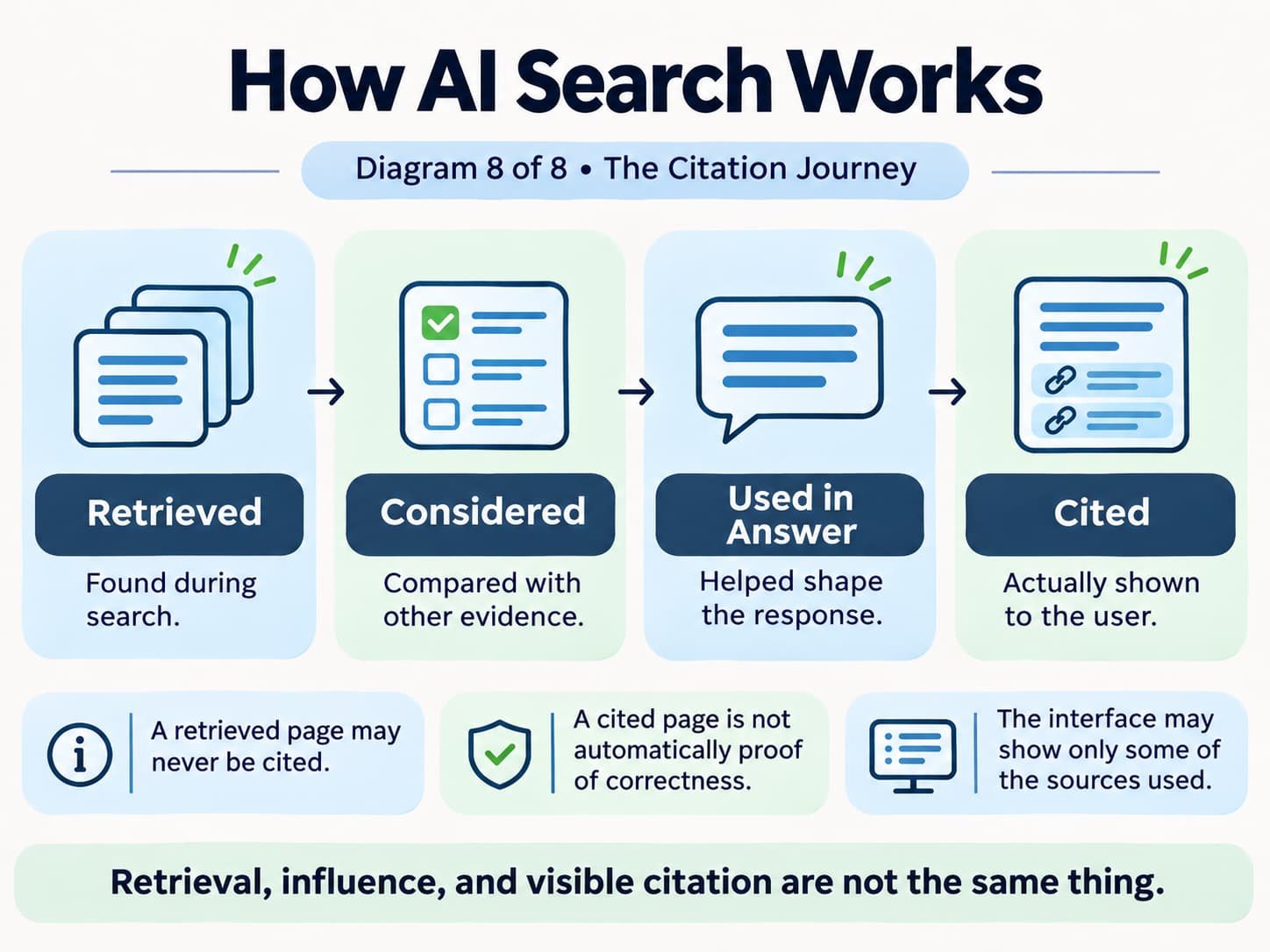
Retrieval, influence, and visible citation are not the same thing.
This is a key limitation when measuring AI search visibility. Search engines don't share enough detail to fully explain how they choose and cite sources for each answer.
What citations mean for website owners
Citations give readers a path from a generated answer back to your website. They're especially valuable when your page offers information readers will want to check or explore further.
Original research, detailed specifications, expert explanations, comparisons, and trusted reference material can all encourage someone to visit a cited page.
But a citation isn't an endorsement, a permanent ranking, or a promise of traffic.
The practical takeaway: Publish information that deserves to be referenced, and judge citations by whether they support the answer, not simply whether your domain appears.
06 · Comparison
HOW AI SEARCH ENGINES DIFFER FROM TRADITIONAL SEARCH ENGINES
AI search hasn't taken over every part of traditional search. Google and Bing used advanced ranking systems, semantic analysis, query rewriting, and structured data well before generative AI was added to search.
The big difference now is how information is presented and used. Traditional search ranks results and helps people find relevant sources. AI search can pull information from multiple sources and create a combined answer before you visit any of them.
| Search function | Traditional search | AI-powered search |
|---|---|---|
| Understanding the query | Interprets keywords, intent, and context | May also decompose complex questions into additional searches |
| Finding information | Retrieves and ranks relevant results | Retrieves information to support answer generation |
| Processing sources | Generates result titles, snippets, and search features | May compare, combine, and summarize evidence |
| Presenting results | Primarily links and search features | Generated responses with supporting links and citations |
| User interaction | Often requires visiting multiple pages | May answer follow-up questions conversationally |
| Common failure | Irrelevant or low-quality results | Retrieval errors, unsupported synthesis, and inaccurate citations |
The difference stands out most when an answer needs information from several sources. With traditional search, you might check the CRM's pricing page, integration docs, and independent reviews yourself. With AI search, the system may try to make that comparison for you.
That convenience brings more responsibility to get the facts right. The search engine isn't just helping you find information. It's interpreting it for you.
07 · Platforms
DO CHATGPT, GOOGLE AI OVERVIEWS, PERPLEXITY, COPILOT, AND GROK WORK THE SAME WAY?
Not quite. These tools share some features, but they differ in where they get information, how they retrieve it, their interfaces, their models, and their design.
Google publicly documents query fan-out for its AI search features and explains that AI Mode and AI Overviews may use different models and techniques.
OpenAI documents query rewriting and additional searches for ChatGPT Search.
Microsoft publishes detailed retrieval techniques for Azure AI Search, but those implementations shouldn't automatically be treated as the internal architecture of every Microsoft Copilot experience.
Perplexity emphasizes web research and sourced responses, but it does not publicly disclose its full internal source-selection algorithms.
Grok offers web-connected information retrieval, but its full proprietary retrieval, grounding, and citation architecture shouldn't be assumed from its visible results.
| Platform | Relevant publicly documented capabilities |
|---|---|
| Google AI Overviews / AI Mode | Query fan-out, integration with Google Search, generated responses, supporting links |
| ChatGPT Search | Query rewriting, web retrieval, additional searches, citations |
| Perplexity | Web research, synthesized answers, source links |
| Microsoft Copilot / Bing | Search-connected answers and citations, with related Microsoft retrieval technologies publicly documented |
| Grok | Web-connected search and generated responses; detailed internal pipeline remains less transparent |
Because of these differences, the same question can produce different answers and sources on each platform. Even on one platform, answers can change with the query, the available information, settings, or the model.
You can't count on one AI search engine to cite a website just because another one did.
08 · Optimization
WHAT AI SEARCH MECHANISMS MEAN FOR SEO
Understanding the technical process shows why AI Search Optimization is more than adding keywords or a special file to your site.
AI Search Optimization, or AISEO, means making your website easier to find, understand, and represent accurately in AI-powered search. Traditional SEO is still a big part of that process.
Google states that existing SEO best practices remain relevant to AI Overviews and AI Mode. According to its documentation, there are no additional requirements to appear in those features, and you don't need new machine-readable files, AI text files, or special schema markup.
You also need to think about how your information might be retrieved and used to create answers.
1. Make important information accessible
A page can't reliably serve as a retrieved web source if the system can't access it. Check for crawling restrictions, indexing issues, and technical errors, and make sure key information is in readable text on the page. Don't put important details only in images or in parts of your site that are hard to reach.
For Google's AI features, a supporting link must be indexed and eligible to appear in Google Search with a snippet. For ChatGPT Search, OpenAI explains that sites can appear in search results by allowing its OAI-SearchBot crawler.
2. Answer specific questions clearly
A page that provides direct, accurate answers gives retrieval systems useful material.
A commercial real estate site, for example, should go beyond saying a property is a great investment. It should list the property's location, available space, allowed uses, lease or sale status, and the other details tenants or buyers want to know.
Specific details are more helpful than promotional language.
3. Build meaningful topical coverage
Query expansion may lead AI search systems to investigate related subtopics. That's a reason to publish content that explains the different sides of a topic.
A legal services website might benefit from separate resources explaining eligibility, deadlines, procedures, costs, and commonly misunderstood rules. Each page should have a distinct purpose and provide substantive information.
Publishing large numbers of interchangeable articles just to capture query variations doesn't create the same value.
4. Support important claims
When your website shares facts, include what people need to check them: documentation, dates, sources, and methods.
Original research, first-hand experience, product documentation, and detailed explanations can offer information that generic summaries miss.
Don't make up statistics or present unsupported claims as facts.
5. Keep information accurate and current
A retrieved page can be technically accessible and still contain outdated information.
Review important content when products, services, prices, regulations, or other relevant circumstances change, and make the date scope clear. For time-sensitive topics, accuracy matters more than a recent update date.
6. Structure content for understanding
Use clear headings, organized sections, helpful internal links, and easy-to-read language. Tables make comparisons clearer, definitions explain specialized terms, and clear qualifications prevent misunderstandings.
Structured data can support traditional search understanding when it accurately represents visible content and follows applicable guidelines. However, no special schema type guarantees that a page will appear in an AI-generated answer.
7. Measure more than traditional rankings
A typical SEO report tracks keyword rankings, impressions, clicks, and organic conversions. AI search visibility requires a few more questions:
- Does the brand appear in answers to relevant questions?
- Is the company's own website cited?
- Which pages are referenced?
- Is the information about the company accurate?
- Which competing sources appear?
- How do results change across platforms and repeated tests?
Collect these observations consistently. Testing a single prompt once isn't enough to know whether your visibility is steady. AI search results can change, and public tools don't show every document that was considered.
The best measurement combines what you see in AI answers with traditional search results and real business outcomes.
09 · Limitations
WHAT AI SEARCH STILL GETS WRONG
AI search can make complex information easier to find, but important limits remain.
- Missing information
- A retrieval system may never find the best source.
- Query drift
- Expanding a question can introduce assumptions or drop essential details.
- Outdated evidence
- Retrieved information may describe products, policies, or events that have changed.
- Conflicting sources
- Different documents may make incompatible claims.
- Unsupported reasoning
- A model may draw a conclusion the available evidence does not justify.
- Citation errors
- A linked page may be irrelevant or fail to support the statement attached to it.
- Manipulated content
- Misleading pages and prompt injection attempts can interfere with the process.
- Inconsistent results
- Similar questions can produce different sources or answers across sessions and platforms.
- Limited transparency
- Proprietary systems generally do not reveal their complete retrieval, ranking, grounding, or citation algorithms.
These aren't small technical issues. They affect how much trust users should place in generated answers, especially when decisions involve money, health, legal matters, or other serious consequences.
AI-generated information is most helpful when you can check the evidence and judge the conclusions for yourself.
10 · FAQ
FREQUENTLY ASKED QUESTIONS ABOUT AI SEARCH
No. Sometimes a system answers using information it already has from the model or the conversation. If it needs more and can retrieve it, it may search the web or other sources. What happens depends on the product, the question, and the tools available.
Query fan-out means a search system issues several related searches across different subtopics or sources to build an answer. Google documents this technique for AI Overviews and AI Mode.
Retrieval-augmented generation, or RAG, is a way to combine information found through retrieval with language generation. An AI search engine is a full product that might use RAG along with search indexes, ranking systems, user interfaces, citation tools, and other technologies.
Google's AI search features use Google's core Search systems. Other AI search products may use different search providers, indexes, or retrieval tools. A strong presence in traditional search can help, but there is no rule that a page must hold a certain position to be cited by an AI search product.
Structured data can help search engines understand information when it follows their guidelines and matches what's shown on the page. But Google doesn't require special AI schema to appear in AI Overviews or AI Mode, and structured data doesn't guarantee AI citations.
Yes. AI answer citations and regular search rankings are different things. A page cited by AI might not be the top traditional result for the same question. How retrieved results, rankings, and citations relate depends on the system.
No. Sometimes a citation points to a page that's outdated, incomplete, or unrelated to the claim. Research such as ALCE shows why citation quality needs to be checked separately from how well an answer reads.
No. Technical accessibility, helpful content, good site structure, relevance, and credibility still matter. AI Search Optimization builds on SEO by looking at how information is found, understood, combined, and referenced in AI-generated answers.
11 · The Bottom Line
AI SEARCH IS AN INFORMATION PROCESS, NOT JUST A RANKING SYSTEM
Traditional SEO asks an important question: "Can search engines find my website and consider it relevant?"
AI Search Optimization adds another: "When an AI system tries to answer a question about my industry, products, or services, can it find and correctly use the information I've published?"
That difference matters because modern search can investigate several questions, pull information from different sources, check the evidence, create a combined answer, and add citations.
Each step is a chance for helpful information to be found. Each step is also a chance for it to be missed or misunderstood.
For businesses and publishers, the goal shouldn't be to outguess a hidden algorithm with shortcuts. Build websites that are easy to access, accurate, informative, and genuinely helpful. The better your information, the stronger the foundation for both your readers and the systems that use it.
AI SEARCH CHANGES HOW ANSWERS ARE GIVEN.
IT DOESN'T CHANGE THE VALUE OF BEING A TRUSTWORTHY SOURCE.
How does AI search see your business?
Get a free AI visibility review. A real person will check how your business shows up across search and AI answers, and tell you what's worth fixing first.
12 · Sources
RESEARCH AND FURTHER READING
This article draws on original research and official technical documentation. These resources provide deeper explanations of the systems and techniques discussed.
- AI Features and Your Website · Google Search CentralOfficial guidance on AI Overviews, AI Mode, query fan-out, and website eligibility.
- Searching the Web with ChatGPT · OpenAI Help CenterDocumentation explaining search queries, query rewriting, and source references.
- Hybrid Search Overview · Microsoft LearnTechnical explanation of hybrid retrieval, vector search, Reciprocal Rank Fusion, and semantic ranking.
- Retrieval-Augmented Generation for Knowledge-Intensive NLP Tasks · Lewis et al., NeurIPS 2020Foundational research combining language generation with external retrieval.
- Precise Zero-Shot Dense Retrieval without Relevance Labels · Gao et al., 2022Introduces Hypothetical Document Embeddings (HyDE) for semantic retrieval.
- Enabling Large Language Models to Generate Text with Citations · Gao et al., EMNLP 2023Research on citation generation and evaluation through the ALCE benchmark.
- RAGAS: Automated Evaluation of Retrieval Augmented Generation · Es et al., 2023Evaluation methods for retrieval relevance and answer faithfulness.
Also referenced:
- Take a Step Back: Evoking Reasoning via Abstraction in Large Language Models · Zheng et al., ICLR 2024Introduces step-back prompting.
- Web Search · OpenAI API documentationSearch actions and url_citation annotations with source URL, title, and location.
- Overview of OpenAI Crawlers · OpenAIOAI-SearchBot and GPTBot robots.txt controls.