HOW TO GET
YOUR BUSINESS
RECOMMENDED BY CHATGPT
Your business might be just what someone needs. But if they ask ChatGPT, will it mention you?
Picture running a business for 20 years. You have a good reputation, loyal customers, and a professional website. Your business shows up on Google, customers leave positive reviews, and word of mouth brings in new clients.
Then a potential customer opens ChatGPT and asks: "Who are the best companies near me for this service?"
ChatGPT recommends three competitors. Your business isn't one of them.
The customer may not realize your business was missed. They start looking into the companies ChatGPT recommended.
The question is no longer just whether customers can find your website.
It's whether AI can find enough reliable information to recommend you.
Why It Matters
AI IS NOW PART OF HOW CUSTOMERS CHOOSE
This is the challenge for companies as AI becomes another tool people use to find products, compare services, and choose who to contact.
For years, businesses worked to show up in Google search results. Now more customers are turning to AI assistants for answers.
The discipline of improving that visibility is commonly called Generative Engine Optimization (GEO), Answer Engine Optimization (AEO), or AI Search Optimization (AISEO). (Here's how those terms compare.)
No one outside OpenAI knows exactly how ChatGPT picks businesses, but research and official documentation offer practical guidance on what you can do.
How It Works
HOW DOES CHATGPT DECIDE WHICH BUSINESSES TO RECOMMEND?
ChatGPT doesn't maintain a public, fixed ranking of the best businesses in every city.
It can answer in different ways, depending on the question, the model, the tools available, and the user's settings. Sometimes ChatGPT uses what it learned during training. Other times, it searches the web for up-to-date information.
That difference is important.
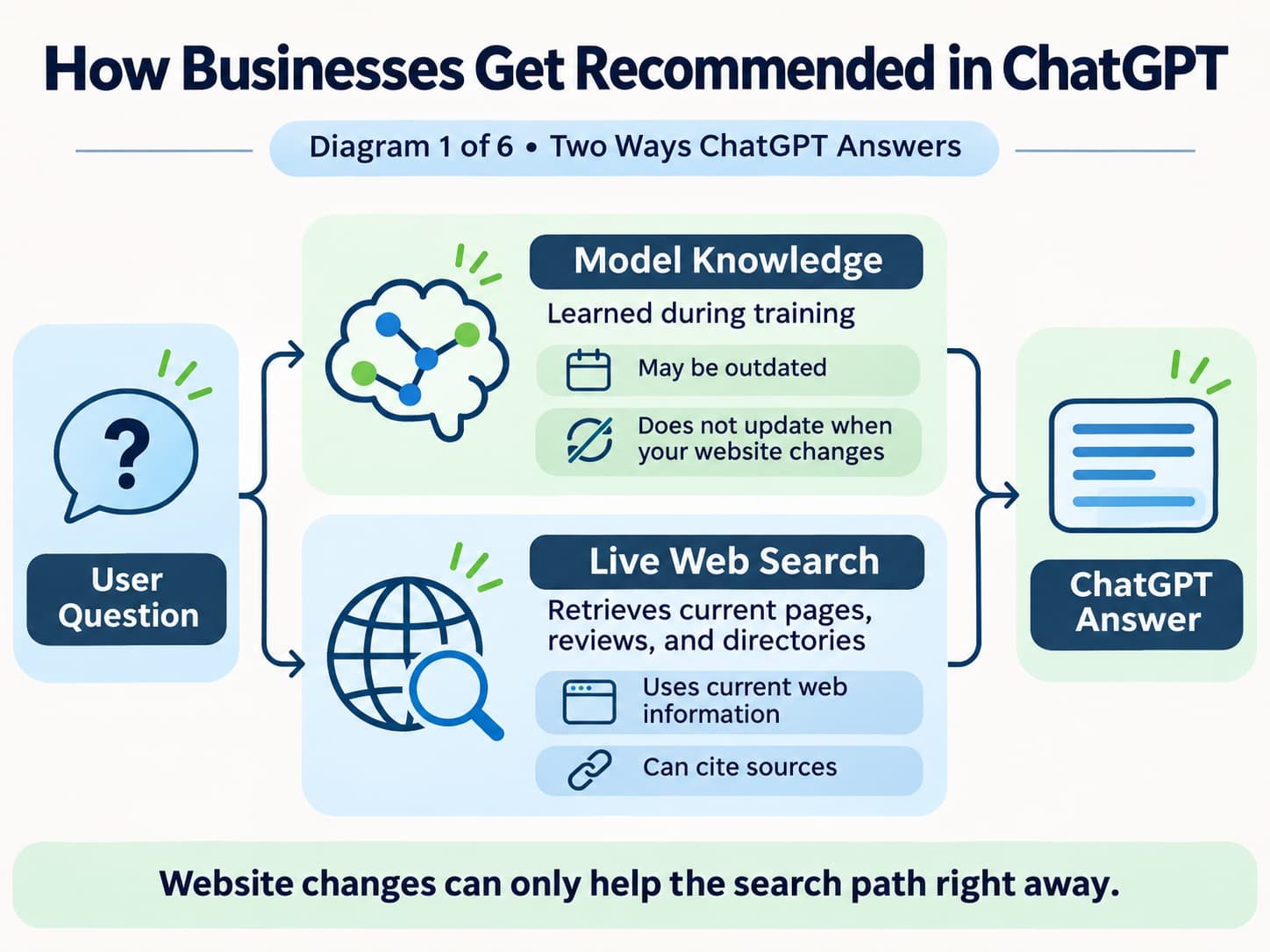
Website changes can only help the search path right away.
1. Recommendations based on existing model knowledge
AI models learn patterns, facts, relationships, and associations from large amounts of information during training. Some businesses may already be familiar to a model because their names, products, services, or histories appeared in training material.
But this knowledge has limits. A new restaurant may have opened after the model's training cutoff. A law firm may have hired new attorneys. A business may have changed its name or moved.
Information learned during training doesn't update when a business adds a new webpage. So even with a great website, ChatGPT might not know your business exists yet.
2. Recommendations based on live web search
When ChatGPT uses search, it can retrieve information from websites and other sources to help answer a question. A user might ask:
- Who are the best commercial real estate brokers in Tyler, Texas?
- What restaurants in East Texas are good for a special occasion?
- Which personal injury attorneys in Tyler handle commercial trucking accidents?
- Where can I buy personalized children's clothing online?
- What website design companies work with small businesses in Texas?
To answer questions like these, ChatGPT may examine relevant pages, identify businesses, and compare the available information. OpenAI says ChatGPT may also use an approximate location based on your IP address to provide relevant local results.
Your website can contribute to that answer. So can reviews, professional directories, news articles, independent guides, and other sources that discuss your business.
First, people need to be able to find you. Being seen as a credible, relevant choice is the harder part.
| Characteristic | Live search | Model knowledge |
|---|---|---|
| New website changes | Can become discoverable | No immediate effect |
| Fresh reviews and articles | May influence retrieved evidence | Not automatically incorporated |
| Crawler controls | Directly relevant | Don't retroactively change training |
| Citations | May appear | Often absent |
| Main opportunity | Retrieval, relevance, evidence | Long-term brand recognition |
Search Behavior
DOES CHATGPT ACTUALLY SEARCH THE INTERNET?
Yes, but not for every question.
An October 2026 Ahrefs study of 66.6 million ChatGPT responses found that 14.4% contained observable search fan-out queries.
That doesn't mean ChatGPT searches the web exactly 14.4% of the time. The study measured one specific kind of search activity in free, logged-out sessions, not every possible form of information retrieval. Ahrefs added a correction making that distinction explicit.
For business owners, the key point is that ChatGPT's search behavior changes with the question.
Ask it to explain a general concept, and it may answer without searching. Ask it to compare current prices, identify businesses in a specific area, or recommend a provider for a specialized service, and current information becomes much more important.
That opens the door for businesses that aren't widely known. A local business doesn't need national recognition to be a good answer to a local question. It needs information ChatGPT can find, understand, and confirm.
The Four Things That Matter Most · 01
MAKE SURE CHATGPT CAN ACCESS YOUR WEBSITE
To help ChatGPT find and mention your business, focus on four priorities. Start with the basics.
OpenAI operates a web crawler called OAI-SearchBot, which surfaces websites in ChatGPT's search features. According to OpenAI's crawler documentation, website owners control whether this crawler can access their content, and sites that opt out won't be shown in ChatGPT search answers.
OpenAI also distinguishes OAI-SearchBot from GPTBot, which crawls content that may be used to train its foundation models. Allowing your website to be discovered in ChatGPT search doesn't require granting the same access for model training.
A basic robots.txt configuration could look like this:
User-agent: OAI-SearchBot
Allow: /

User-agent: GPTBot
Disallow: /
This setup allows search crawling but blocks GPTBot. Add it to your existing robots.txt file without removing other important rules.
But robots.txt is only one part of the process.
Even if your website allows OpenAI's crawler, the request might still be blocked by your hosting firewall, security service, or content delivery network. OpenAI publishes the IP addresses its search crawler uses, so those services can be configured to let it through.
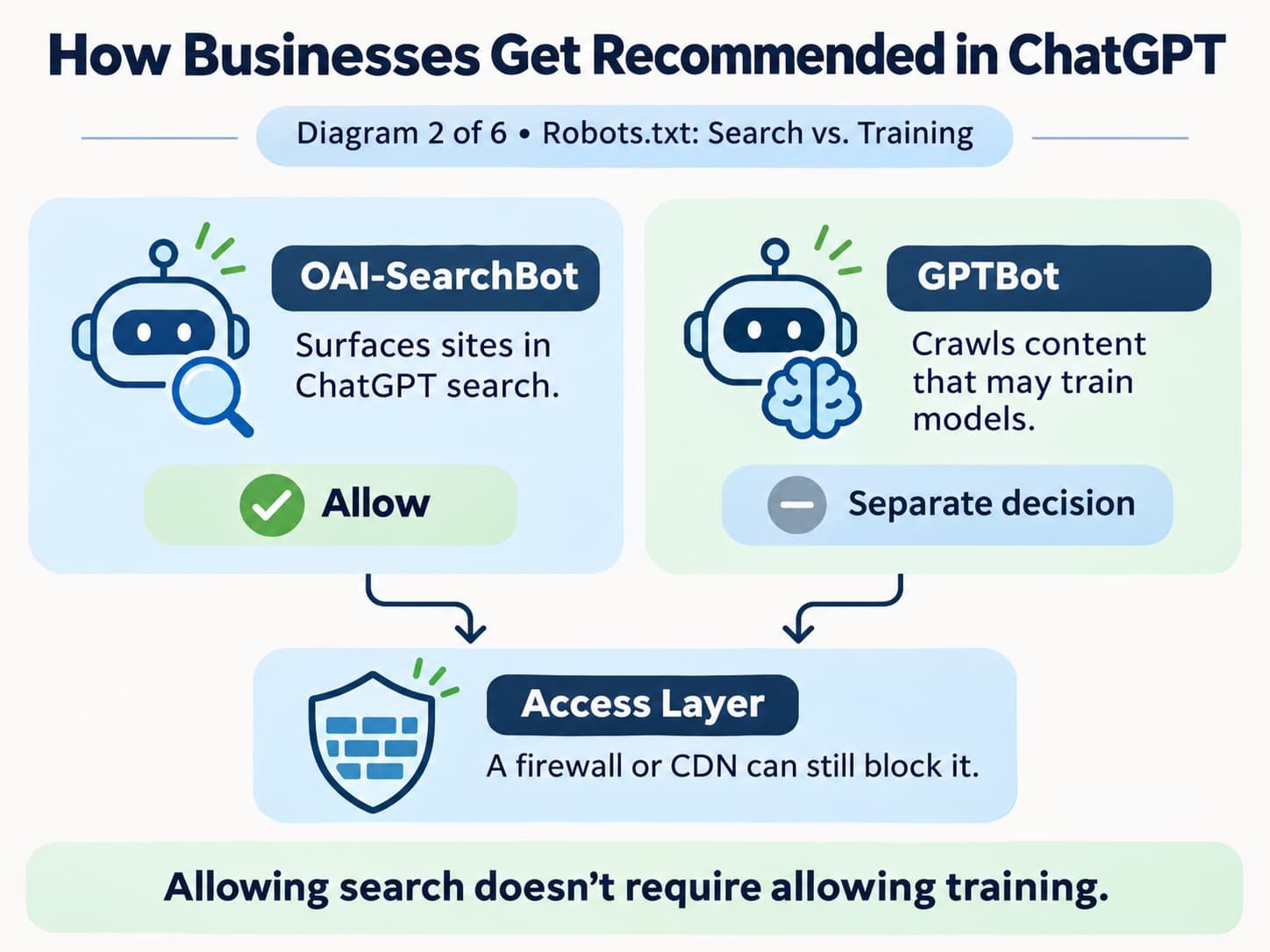
Allowing search doesn't require allowing training.
Other common issues include pages that need JavaScript to show key information, broken links, wrong canonical tags, and important pages marked noindex.
Ask your website developer to confirm that important public pages are accessible, load correctly, and contain useful information that can be read without clicking or interacting.
This won't guarantee a ChatGPT recommendation. But if your website can't be accessed, you're already at a disadvantage.
The Four Things That Matter Most · 02
GIVE CHATGPT SOMETHING WORTH UNDERSTANDING
Imagine two commercial real estate companies.
"We provide exceptional real estate solutions and unmatched customer service."
"Our Tyler, Texas commercial real estate team helps property owners and businesses with industrial leasing, office leasing, site selection, investment sales, and commercial property management throughout East Texas."
The second statement gives far more useful information. It tells you the business type, services, location, and who the customers are.
Unfortunately, many websites are filled with phrases like "committed to excellence," "industry-leading solutions," and "your trusted partner." They might sound nice, but they don't explain what the business does.
A better website answers the questions your customers already have:
- A law firm: which types of cases it handles, where its attorneys practice, and who will work on a client's case.
- A restaurant: its menu, location, atmosphere, hours, reservation options, and the occasions it suits.
- An online retailer: product materials, sizes, availability, personalization options, shipping, and returns.
- A digital marketing agency: services offered, industries served, project examples, and the people responsible for the work.
The goal isn't to fill every paragraph with keywords. It's to give enough specific detail that a customer, search engine, or AI assistant can clearly understand your business.
Answer the question first
When someone asks what a service includes, answer the question before launching into a sales pitch.
- Use clear headings that reflect real questions.
- Explain technical terms in simple, everyday language.
- Provide specific facts wherever possible.
- Support important claims with verifiable details.
A useful page should make sense to someone who knows nothing about your company.
And when things change, update your information. Old service lists, wrong phone numbers, outdated prices, and old staff bios make it harder for customers to trust your business.
The Four Things That Matter Most · 03
BUILD A REPUTATION BEYOND YOUR OWN WEBSITE
This might be the most overlooked part of AI Search Optimization.
Your website tells people what you say about your business. Other websites can provide independent evidence of what your business actually does and how people experience it.
A company's homepage may claim outstanding service. But a customer comparing providers also wants to know whether the business has relevant experience, professional credentials, authentic customer feedback, or recognition from independent sources.
AI systems can draw on that wider range of information too, and recent research shows a meaningful relationship between third-party brand mentions and AI visibility.
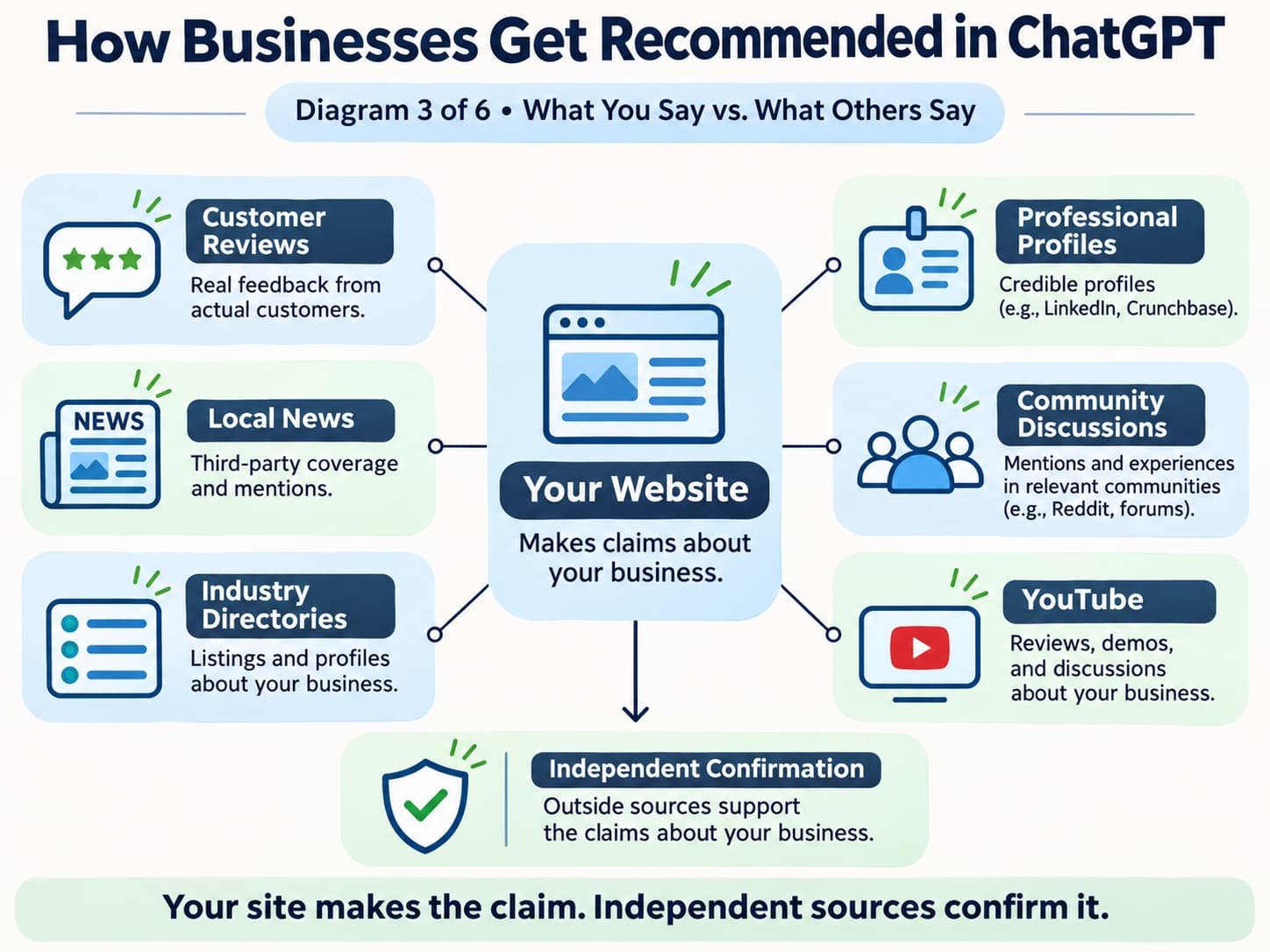
Your site makes the claim. Independent sources confirm it.
What a study of 260 million AI prompts found
In November 2026, Ahrefs published research examining 10,000 brands and 260 million non-branded prompts across Google AI Overviews, Google AI Mode, and ChatGPT.
Researchers compared how often brands were mentioned on independent websites, in news articles, on Reddit, YouTube, and other sources with how often those brands appeared in AI-generated answers. They found a strong connection.
| Type of brand mention | Correlation with AI visibility |
|---|---|
| Reddit discussions | 0.75 |
| Mentions across independent domains | 0.70 |
| Mentions across webpages | 0.70 |
| News coverage | 0.67 |
| YouTube mentions | 0.64 |
| TikTok mentions | 0.60 |
Spearman correlations combined across Google AI Overviews, AI Mode, and ChatGPT. Source: Ahrefs, November 3, 2026.
These numbers are statistical relationships across several AI platforms, not ChatGPT ranking weights. ChatGPT's own correlations were somewhat weaker, mostly between 0.60 and 0.65.
The researchers also found that brands with more independent mentions usually got more AI mentions, even when compared with businesses of similar search popularity, though the relationship was weaker within those groups. Returns also diminished: a brand with 10 times more webpage mentions typically had about 3.7 times more AI mentions, not 10 times more.
But connection isn't causation. The study doesn't prove that ten new articles, Reddit mentions, or video references will make ChatGPT recommend a business.
What it does show is that businesses mentioned more often online also tend to show up more in AI answers. That backs up what successful businesses have done for years: build a real reputation that goes beyond your own advertising.
Independent coverage matters
Another important study came from Muck Rack. Its October 2026 What Is AI Reading? report examined more than 40 million AI responses and 207 million citations across ChatGPT, Claude, Gemini, and Perplexity.
of cited links came from journalism, government and NGO websites, academic research, encyclopedic sources, and third-party corporate content.
of cited links came from non-paid sources.
That doesn't mean traditional public relations alone decides which businesses ChatGPT recommends. The research covered several AI platforms and many kinds of questions.
But it reinforces an important point: a business can't build a trustworthy online reputation just by talking about itself. Other people and organizations need real reasons to mention it.
How can a small business earn those mentions?
The best opportunities depend on your industry.
- A restaurant might earn coverage through local dining publications, community events, and authentic customer reviews.
- A law firm might contribute qualified legal analysis, maintain accurate professional listings, and comment usefully on developments in its practice areas.
- A commercial real estate company might publish original market observations, verified transaction announcements, or educational resources for property owners.
- An online retailer might earn product reviews, coverage from relevant publishers, or mentions in genuine customer discussions.
- A digital marketing agency might publish original research, explain technical developments, or document projects with verifiable results.
The key is relevance. A mention in a publication your customers actually read can be worth more than a listing on a site no one in your industry visits.
You don't need fake reviews, paid compliments, made-up forum posts, or mass-produced press releases. Shortcuts like these are risky and don't build real authority.
The Four Things That Matter Most · 04
MAKE YOUR BUSINESS EASY TO IDENTIFY
Think about what happens when a company changes its name.
Its website uses the new name. Its Google Business Profile uses the old one. An industry directory lists a previous address. LinkedIn shows an outdated description.
Someone researching the company could get confused. Automated systems trying to match up those references can run into the same confusion.
This is an entity consistency problem. In search technology, an entity is a recognizable real-world thing, such as a business, person, product, or place. Your goal is to make your business easy to tell apart from others and link to the right information.
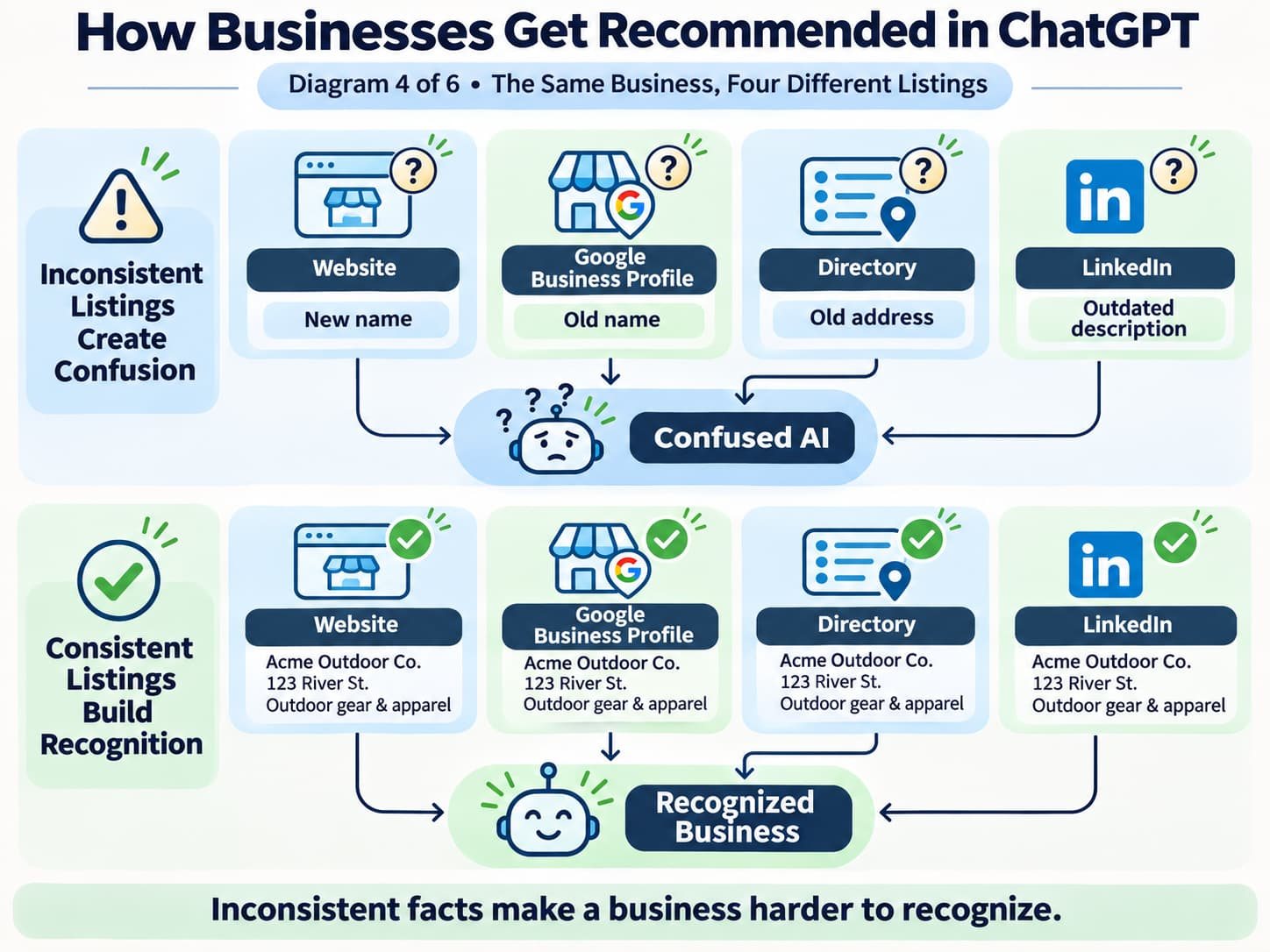
Inconsistent facts make a business harder to recognize. Example business is fictional.
Start with the fundamentals:
- A consistent public business name
- An accurate description of what the company does
- Correct website and contact information
- Clearly identified locations and service areas
- Accurate business categories
- Current professional and social profiles
- Verified leadership information
- Relevant professional credentials
- Consistent references across reputable directories
Structured data, including Schema.org's Organization and LocalBusiness types, can describe these facts in machine-readable form. But structured data alone won't guarantee recommendations. There's no solid evidence that adding Organization schema makes ChatGPT choose your company over a competitor.
Use schema to describe your business accurately, and focus on publishing the information people actually want to find.
Small Business Opportunity
DOES YOUR BUSINESS NEED TO BE FAMOUS TO APPEAR IN CHATGPT?
No. A business doesn't have to be nationally known to matter to a specific customer.
Someone looking for a commercial property manager in Tyler probably isn't interested in the biggest real estate companies in the country. They want someone who knows the local market and offers the right service.
Someone searching for an attorney after a truck accident needs a professional qualified to handle that kind of case in the right area.
A person shopping for monogrammed kids' clothes might care more about personalization, quality, stock, and delivery times than about how big the retailer is.
That gives small and midsize businesses a real opportunity. Being specific can make your business more relevant to certain questions, even when bigger competitors are better known overall.
But specificity has to be supported by facts. Saying you're the best commercial broker in Tyler isn't proof that you are. Explaining what you really do, showing your experience, and sharing trustworthy information helps people judge your business fairly.
Timeline
HOW LONG DOES IT TAKE TO SHOW UP IN CHATGPT?
There's no set timeline.
Some technical corrections can be made immediately. OpenAI says robots.txt changes can take about 24 hours to reach its search systems.
But a crawler being able to access your site doesn't mean the site is indexed, and being indexed doesn't guarantee a recommendation. A new page might show up in search systems before your business has enough independent information to compete for a recommendation.
A new article from a respected source can help build evidence about your company, but there's no set waiting period before it affects ChatGPT.
For planning purposes, think in three stages:
- First 30 daysEstablish the foundation
Audit website access, correct inconsistent business information, identify the questions customers ask, and improve important pages.
- Days 31–60Build relevant evidence
Publish substantive resources, document expertise, pursue appropriate independent coverage, and strengthen legitimate industry profiles.
- Days 61–90Measure and refine
Evaluate which questions produce business mentions, which sources are cited, where competitors appear, and whether changes hold up.
These are reasonable planning periods, not guaranteed deadlines. The point is to make measurable progress instead of expecting one website change to produce immediate recommendations.
Measurement
HOW DO YOU KNOW WHETHER CHATGPT IS RECOMMENDING YOUR BUSINESS?
Don't depend on just one question. AI-generated answers can change from one session to the next, even when questions are worded almost the same.
In October 2026, Ahrefs published a study tracking about 37,500 citations across five AI tools for 20 days. Depending on the platform, 50% to 83% of citations disappeared the next day; for ChatGPT, it was 59%. But roughly three-quarters of the citations that disappeared came back at some point during the study.
That volatility matters. A business might appear in ChatGPT on Monday, disappear on Tuesday, and return later in the week. One appearance doesn't prove your changes worked, and one absence doesn't mean something went wrong.
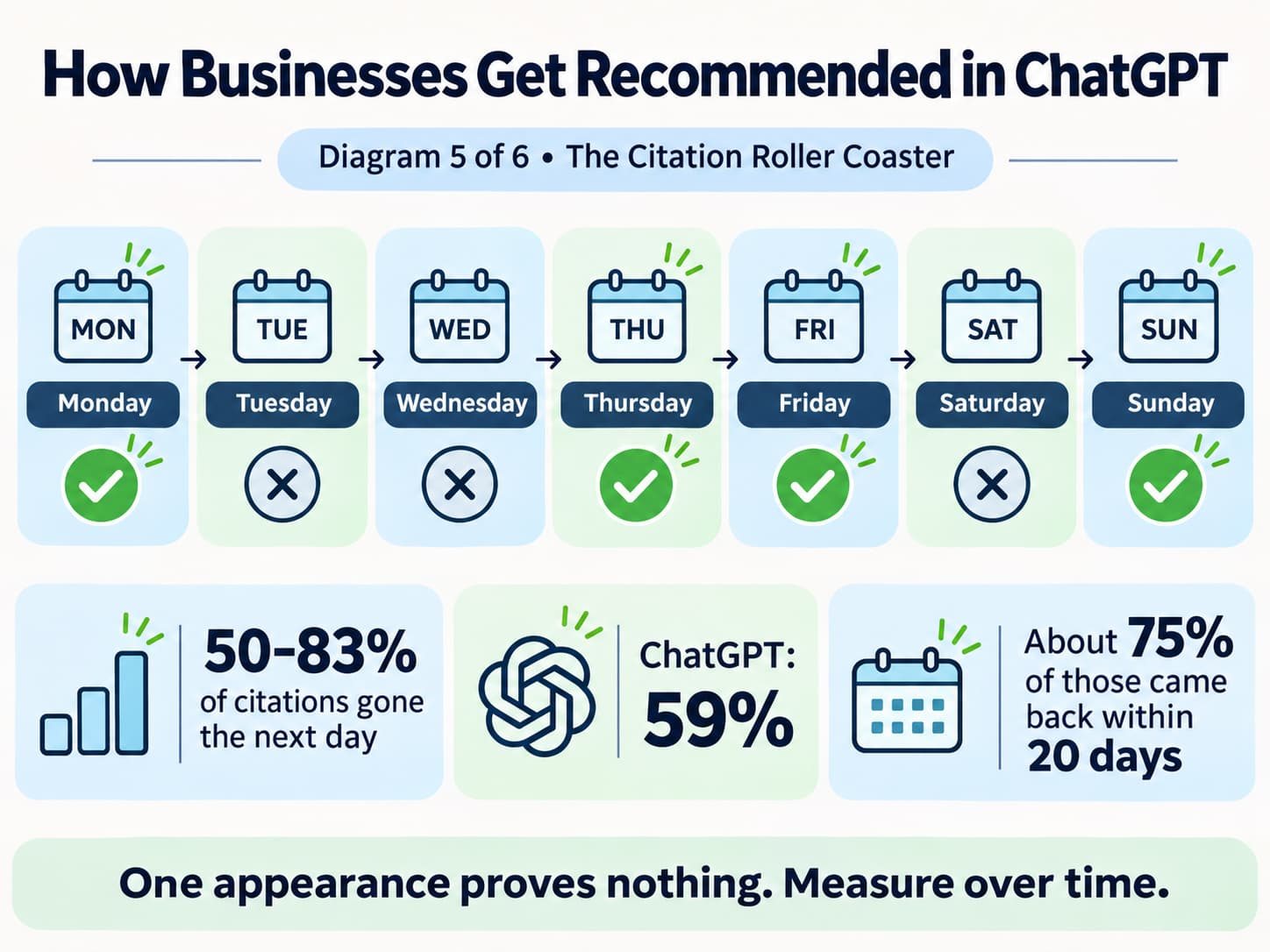
One appearance proves nothing. Measure over time. Figures: Ahrefs, October 29, 2026.
A better way to measure AI search visibility
Start with 15 to 30 questions your actual customers might ask. Include several types:
- Discovery
- "Who are the best website designers in Tyler, Texas?"
- Service-specific
- "Which companies build secure client portals for businesses?"
- Comparison
- "Which digital marketing agencies in East Texas specialize in Google Ads and website design?"
- Problem-solving
- "Who can help my business appear more often in AI search results?"
Ask those questions regularly over time. Record whether your business was mentioned, whether it was recommended, whether ChatGPT searched the web, and which sources it used. Note which competitors show up in the same answers.
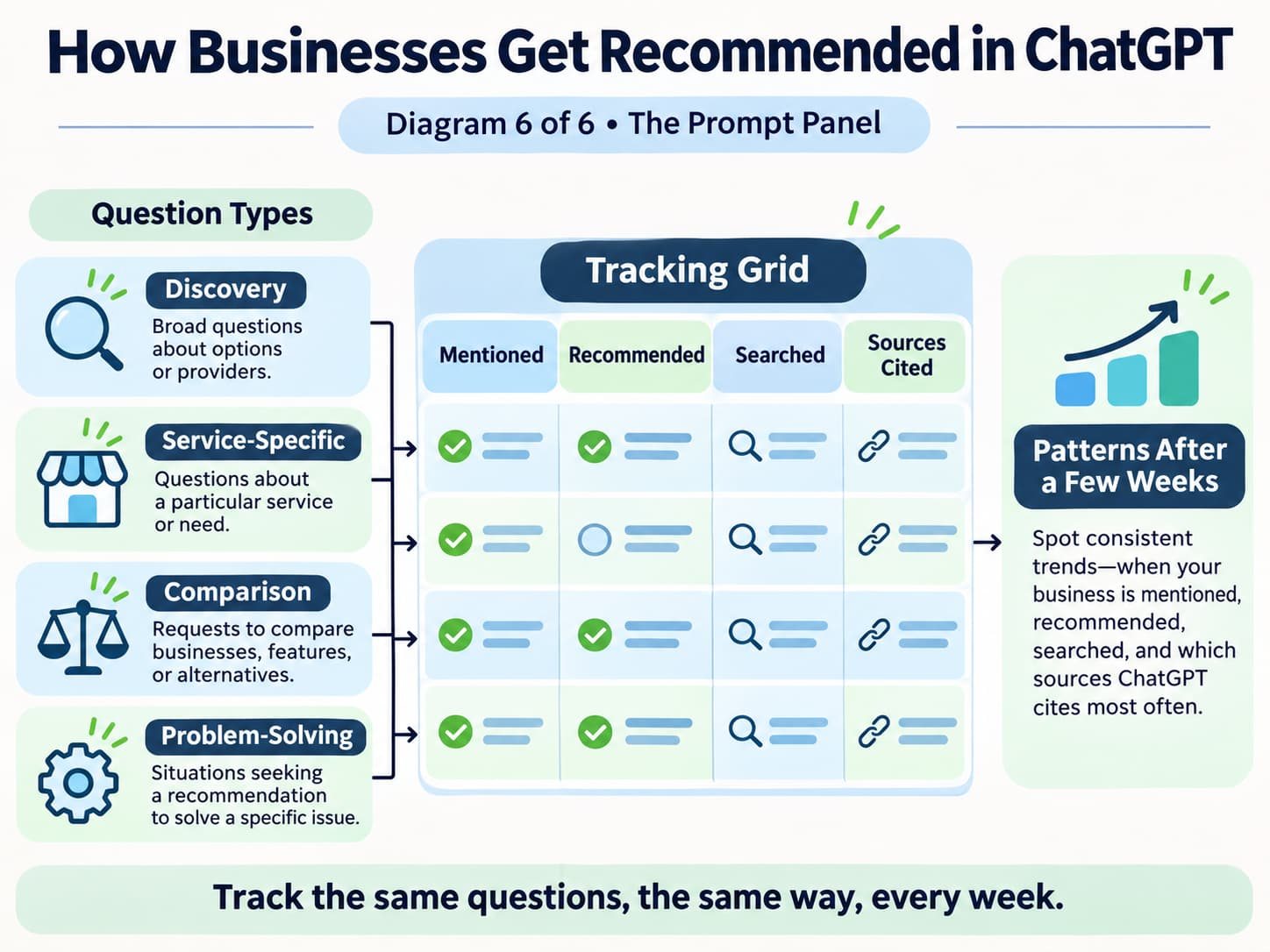
Track the same questions, the same way, every week.
After a few weeks, patterns start to appear. You might find that competitors are featured more often in certain industry publications. You might notice that ChatGPT recognizes your company's name but gets your services wrong. Or you might spot a technical issue that keeps your most important pages from showing up.
Those discoveries give you clear problems to work on. The aim isn't to celebrate one good answer, but to become a reliable choice for the questions your customers care about.
Shortcuts
WHAT ABOUT LLMS.TXT, SPECIAL AI SCHEMA, AND OTHER GEO TRICKS?
AI Search Optimization has attracted a lot of big promises. Some involve useful technical concepts. Others make claims research doesn't support.
One popular suggestion is adding an llms.txt file, intended to organize content for language models. That kind of file can help in systems designed to use it. But there's no solid evidence that adding llms.txt makes ChatGPT more likely to recommend your business.
Google's official guidance for generative AI search explicitly states that Google Search ignores llms.txt files and that no special schema markup is required. That guidance is about Google, not ChatGPT, but it shows why businesses should be cautious about broad promises of easy AI shortcuts.
Be careful, too, about mass-producing AI-written articles, piling on FAQ markup, or paying for generic third-party mentions.
- More content isn't automatically better content.
- More mentions don't automatically make a business more credible.
- Technically correct files can't make up for a website that doesn't clearly explain what the business does.
The best approach is to improve the information and evidence about your business, then measure whether those changes help people find you.
AISEO vs. SEO
IS AI SEARCH OPTIMIZATION DIFFERENT FROM TRADITIONAL SEO?
Yes, but the two share important foundations.
Traditional SEO helps websites show up in search results and be useful to the people searching. AI Search Optimization also asks whether AI assistants can understand your business, match it to specific questions, and use information from different sources in their answers. (For the mechanics, see how AI search engines work.)
That creates new measurement challenges:
- Your website might get a prominent citation even when your company isn't actually recommended.
- A brand may be mentioned without its website receiving a visit.
- An AI-generated answer might shape a customer's decision even if they never click your link.
That's why traditional rankings and organic traffic don't tell the whole story about AI visibility.
Still, the basics matter. An accessible website, helpful content, accurate business information, and real authority are still valuable. The difference now is that businesses also need to watch how they show up in AI-generated answers, not just where their pages rank.
Start Here
WHAT SHOULD YOUR BUSINESS DO FIRST?
You don't have to rebuild your website or try every new AI optimization tactic. Start by answering these five questions.
- 01Can ChatGPT reach the important pages on your website?
Check crawler permissions, hosting security, and whether your site is technically accessible.
- 02Does your website clearly say what you do and who your customers are?
Go beyond marketing slogans. Make sure customers can easily find clear, accurate information.
- 03Can trusted sources confirm your experience and reputation?
Check relevant directories, independent publications, real customer reviews, and professional profiles.
- 04Is your business information consistent across the web?
Update old names, services, addresses, and descriptions.
- 05Do you know whether ChatGPT currently recommends your business?
Test real customer questions, record the results, and track changes over time.
These five questions are a stronger starting point than chasing unproven ranking tricks.
The Bottom Line
BUSINESSES THAT ADAPT WILL BE EASIER TO FIND
Go back to the business owner from the start: a good reputation, happy customers, competitive services. But when someone asks ChatGPT for a recommendation, the company doesn't show up.
That doesn't mean the business is worse than its competitors. It could mean the website is hard to access, the services aren't explained well, the public information is inconsistent, or competitors have more evidence of their relevance.
Those are issues a business can investigate and fix. The goal is to make the company's real strengths easier to find and verify.
Over time, that work can strengthen traditional search visibility, improve what potential customers see, and create more chances to appear in AI-generated answers.
THERE ARE NO GUARANTEED SHORTCUTS TO CHATGPT'S TOP RECOMMENDATION.
THERE IS A REAL PATH TO BEING EASIER TO FIND, BETTER DOCUMENTED, AND MORE TRUSTED.
That's worth working toward, no matter which AI assistant your customers use next.
Find out what ChatGPT says about your business
Your next customer might already be asking ChatGPT about businesses like yours. Ryan Bailes helps Texas businesses see and improve how they show up in AI-powered search, including ChatGPT, Google AI Overviews, and other new discovery platforms.
A free AI visibility review shows whether your business appears for relevant customer questions, which competitors are being recommended, and what may be limiting your visibility.
No guaranteed rankings. No mysterious AI tricks. Just practical research, technical expertise, and a strategy built around your business.
Sources
RESEARCH AND SOURCES
This article was last reviewed on November 10, 2026. These sources inform its technical recommendations and research findings.
- Overview of OpenAI Crawlers · OpenAIOfficial documentation covering OAI-SearchBot, GPTBot, ChatGPT-User, published crawler IP addresses, and robots.txt timing.
- Searching the Web with ChatGPT · OpenAI Help CenterHow ChatGPT search rewrites queries, uses search providers, and uses approximate location for local results.
- How ChatGPT Does Query Fan-Out · Ahrefs, October 12, 2026Analysis of 66.6 million ChatGPT responses and about 15 million fan-out queries.
- Which Types of Mentions Correlate the Strongest With AI Visibility? · Ahrefs, November 3, 2026Study of 10,000 brands and 260 million non-branded prompts.
- What Is AI Reading? · Muck Rack, October 2026Earned-media and third-party sources cited by AI systems.
- How Stable Are AI Citations? · Ahrefs, October 29, 2026Twenty-day analysis of about 37,500 citations across five AI tools.
- Optimizing Your Website for Generative AI Features on Google Search · Google Search CentralOfficial guidance on generative AI search, including schema and llms.txt.